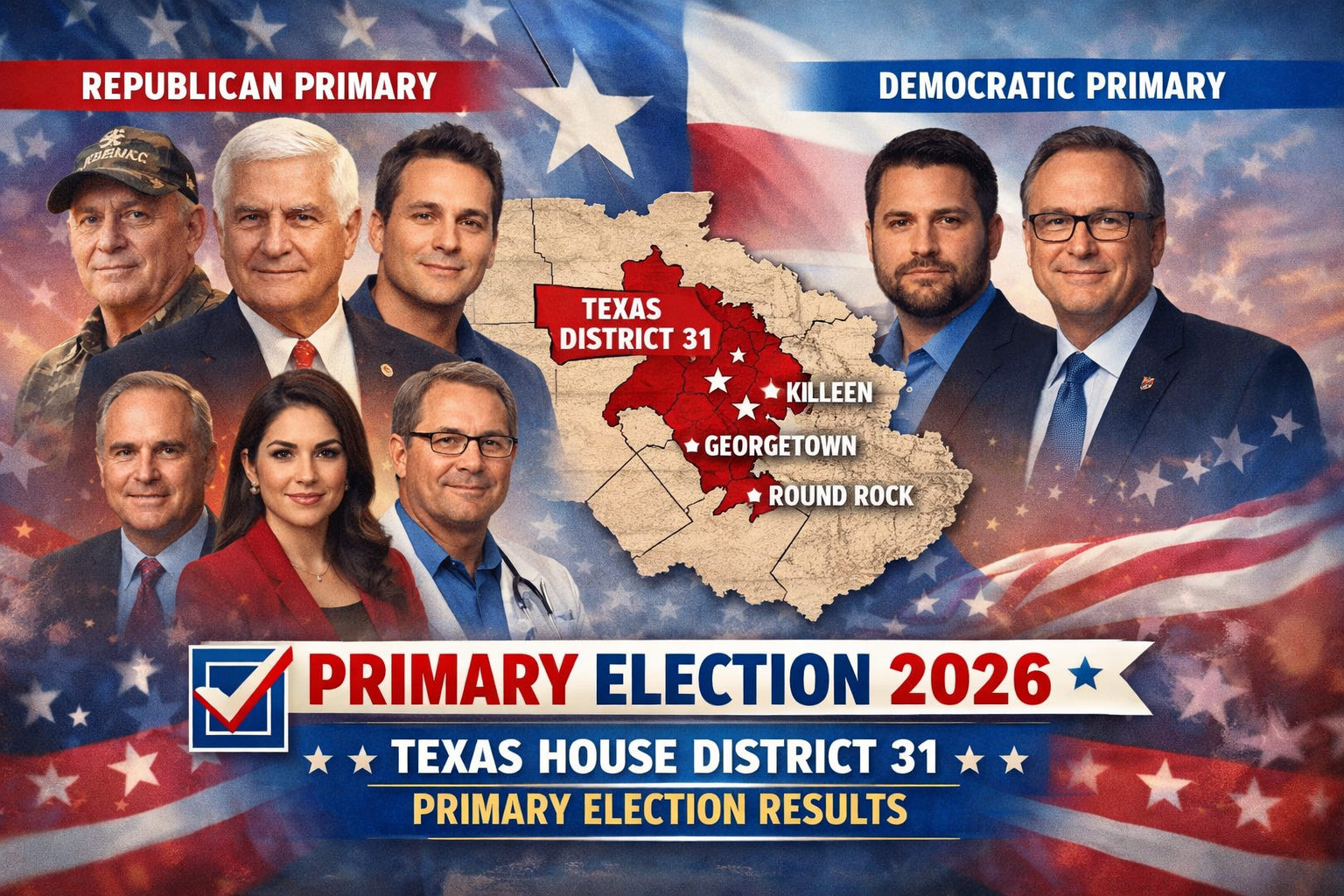
Everybody’s eyes are on the Texas Primary Election Results 2026. The Texas House District 31 Primary Election held on 3rd March 2026. It was a key part of the larger Texas Primary Voting Cycle that also included statewide competition of governor, US Senate and local offices. These elections are crucial for both major political parties and voters to decide the direction of their representation in the US House of Representatives ahead of the general election on November 3, 2026.
Texas House Primary Election Results 2026
Texas’ 31st Congressional District includes a diverse area of Central Texas, stretching from the northern suburbs of Austin through Georgetown and up toward Killeen, Temple, and the Fort Hood area. The district mixes suburban growth with rural and military communities, creating a complex group of voters for candidates seeking federal office.
As the 2026 primary approached, Carter faced a crowded Republican field. Democratic challengers were also preparing for competitive races in a district that has historically leaned Republican.
Candidates: Republicans vs. Democrats
Republican Contenders
In the Republican primary for District 31, a large number of candidates sought the nomination, showing both local discontent and national interest in the seat:
John Carter (Incumbent): The longtime Congressman aimed for renomination to continue serving the district after over two decades in office.
William Abel: A U.S. Army veteran with experience advocating for veterans.
David Berry: A doctor who campaigned on health and local economic issues.
Steve Dowell: Another candidate with a military background hoping for a conservative role in federal office.
Abhiram Garapati: A real estate investor focused on local business development.
Valentina Gomez: A financial strategist with previous campaign experience.
Raymond Hamden: A real estate broker involved in regional development.
Elvis Lossa: A policy coordinator with local political connections.
Vince Offer: Known as an infomercial pitchman and media personality, his candidacy drew attention for its novelty.
This wide field highlighted internal Republican dynamics and challengers’ desire to push the incumbent on issues like economic policy, national security, and voter engagement.
Democratic Challengers
On the Democratic side, the primary featured a smaller but serious contest between two candidates, both looking to energize Democratic voters in a red-leaning district:
Justin Early: A cybersecurity expert campaigning on modern economic and safety issues.
Stuart Whitlow: An attorney who was the Democratic nominee in the 2024 cycle.
Although Democrats have historically struggled in District 31, demographic changes and increased engagement among minority and suburban voters have made the contest more competitive than in the past.
Texas Primary Election Results 2026: What We Know
As of this reporting, primary results for District 31 had not been fully counted, with many local races still being tabulated and unofficial results circulating. Preliminary news reports suggest that the primary drew significant attention and that vote counting was slow as the election cycle progressed.
Local sources reported that incumbent Congressman John Carter was facing a competitive Republican primary, though final vote totals had not yet been released.
On the Democratic side, early results showed Justin Early and Stuart Whitlow were competing for the nomination in what was expected to be a clearer but still competitive race.
Texas law requires candidates to secure a majority (more than 50%) to avoid a runoff. Many observers believed that if no clear leader emerged in either party, a primary runoff election would be scheduled for May 26, 2026.
Voter Turnout, Trends, and Broader Primary Context
Primary elections in Texas, especially in midterm years, often attract lower turnout than general elections. However, the 2026 primary saw higher voter participation compared to recent cycles, particularly among younger and first-time voters who expressed strong interest in both local and federal races.
Statewide, the primary coincided with competitive races for governor (where both parties were vying for nominations) and the U.S. Senate, where no leading candidates secured outright majorities.
Local news pointed out that issues in election administration, including changes in precinct locations and updated voting rules, caused confusion among voters in some counties. This led to legal discussions and extended polling hours, particularly in larger urban centers like Dallas and Williamson Counties.
These factors made the counting process more complicated and highlighted ongoing concerns about election management in rapidly growing areas of Texas.
Implications for the General Election
As District 31 approaches the general election in November, primary results will determine whether the Republican nominee—likely the incumbent if he receives enough votes—faces a Democratic challenger in a race that could reflect broader trends in Texas politics.
Analysts view District 31 as a Republican-leaning seat, based on recent election history and voting patterns. Republicans have generally won this district in presidential and congressional races, with GOP incumbents usually holding significant leads.
However, demographic changes, including suburban growth and increased turnout among younger and minority voters, suggest that District 31 could become more competitive in future elections. This makes the 2026 general election a key focus for both parties as they refine their strategies, not just locally, but across the state.
Additionally, national attention on some Texas primaries, especially the U.S. Senate contest and gubernatorial race, may boost turnout in down-ballot races, including District 31.
Conclusion: A Closely Watched Race in a Changing Political Landscape
The primary election results for Texas House District 31 in 2026 show both continuity and change in Texas politics. With a veteran Republican incumbent facing challengers from his party and Democrats bringing candidates eager to make gains, the primary highlighted the excitement and competitiveness of local democracy.
While final numbers have not yet been universally certified, preliminary reports suggest a challenging and closely watched primary. As results are finalized and possible runoffs are considered, attention will soon turn to the November general election, where voters across District 31 will have the opportunity to influence their representation and impact broader political trends in Texas and the nation.
If you’d like, I can also provide a summary version or include graphics of the vote breakdown once the official results are available.

- Trade Jobs in USA: Check Best Career Options Without College (2026 Guide) - April 9, 2026
- Best Career Options without a Degree in USA (High Salary Jobs 2026) - April 8, 2026
- CBSE 10th Result 2026 Big Update: Result Date, Check New Notice - March 27, 2026